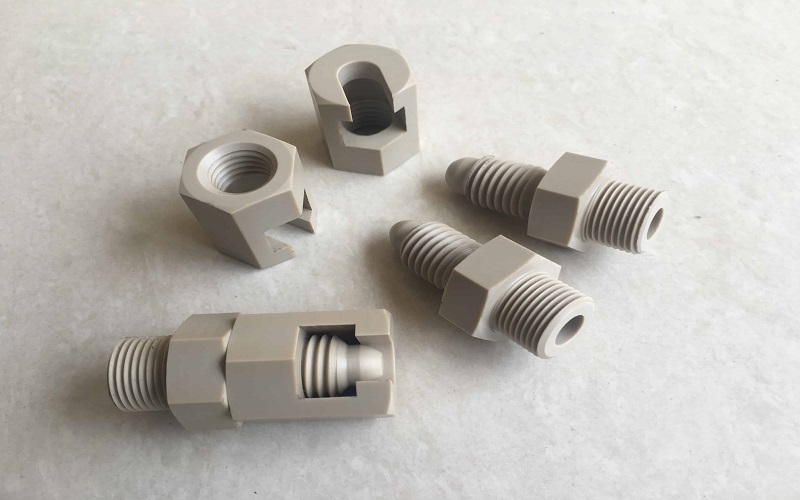
The trend of swapping metals for high-performance polymers like PTFE, PEEK, Nylon and UHMWPE has been consistently gaining momentum as new polymer variants are introduced. Substituting metals with polymers offers weight savings, chemical inertness and design flexibility that metals cannot always match.
However, despite the advantages of polymers, they still suffer from one perennial disadvantage: they do not bite on threads or localised loads as well as metals do. A bolt directly torqued into a tapped polymer hole will strip, creep or loosen with repeated assembly cycles or sustained vibration.
The solution is elegant in its simplicity: the metallic insert.
Using the insert, we create a component that exceeds the sum of its parts. By adding a small metal element at the point of load concentration we combine the bulk properties of the polymer with the localised strength of the metal.
Why insert anything?
The requirement of the metallic insert is based on the basic mechanics of polymers. The strongest engineering plastics have tensile and shear strengths that are an order of magnitude lower than those of steel or brass. More importantly, polymers are viscoelastic, i.e., they creep. A thread formed directly into a polymer will slowly deform over time under the sustained clamping load of a fastener, resulting in a relaxation of the joint and a loss of preload. This is especially true of a soft polymer, like PTFE, where the process of even making a thread in the material requires the use of specialised forming tools.
The problem is further compounded in applications that are disassembled frequently, such as inspection covers, modular housings, jigs and fixtures, where every assembly cycle wears the polymer thread slightly more.
Inserts address this issue by taking the concentrated stresses of the fastener and placing them into a metal element, which then distributes the load over a much larger area of the surrounding polymer. The polymer is never tasked with performing what it is poor at—resisting point loads and thread shear—and is allowed to do what it is good at: providing a lightweight, chemically inert, low-friction body.

Besides their use in threading, inserts are used as bearing surfaces, electrical contact points, alignment bushes and reinforcement sleeves in machined polymer components.
Types of Inserts and Their Installation
The choice of insert depends on the polymer type, the loads and the stage of manufacture when the insert is introduced. The options generally break down into five categories:
- Press-fit (interference) inserts: The easiest method, where the insert is pressed into a slightly undersized machined hole. The elasticity of the polymer grips the insert naturally. The outer surfaces can be knurled or grooved to improve retention. This method is suitable for softer, tougher polymers such as PTFE and UHMWPE, where the material compliance allows a strong elastic grip without cracking.
- Thermal (heat-staked) inserts: The insert is heated and pressed into the polymer. The local melting of the material allows it to flow into the knurls and undercuts of the insert and re-solidify. This provides a close mechanical interlock and works very well in thermoplastics such as Nylon, POM and PEEK. However, it is not suitable for PTFE, which does not flow as required.
- Ultrasonic inserts: Thermal installation variant. The ultrasonic vibration produces frictional heat at the interface between the insert and the polymer. The result is similar: localised melting and reflow around the insert geometry. The advantage is very short cycle times in production situations.
- Threaded and helical inserts: Self-tapping inserts create their own thread in a pre-drilled hole. Helical wire inserts (commonly referred to by trade names such as Heli-Coil®) are spun into a pre-tapped thread. Both are well suited to harder machinable polymers such as PEEK, PPS and glass-filled grades where the base material has sufficient shear strength to support the engagement.
- Moulded-in inserts: When parts are made by injection or compression moulding rather than just machining, the insert is placed in the mould cavity, and the polymer is formed around it. This method has the highest retention strength of all since the polymer surrounds the knurls, flanges and undercuts of the insert. Insert moulding is often used with materials such as PPS and PEEK for automotive and electrical assemblies.
The most common inserts in machined parts are press-fit, thermal and threaded since they can be added after the part geometry is finished. The machining itself is critical: the receiving hole must be held to tight tolerances—typically within a few hundredths of a millimetre. An oversized hole destroys retention, while an undersized one risks stress-cracking the polymer during installation.
What the Insert Offers – And How It Is Fixed?
The performance of a polymer part is improved in several measurable ways with a well-defined insert:
- Pullout & torque resistance: Retention features, including knurls, circumferential grooves, and hexagonal or slotted profiles, engage the polymer and resist both axial pull-out and rotational torque. Axial grooves resist rotation. Circumferential grooves resist pull-out Most commercial inserts are combinations.
- Distribution of load: The insert distributes clamping forces over a large polymer contact area, keeping local stresses below the material creep threshold. The joint is then preloaded for years of service rather than months.
- Reusability: Metal-to-metal thread engagement allows hundreds of assembly cycles without degradation, a must for serviceable equipment.
- Dimensional stability: A metallic bush preserves bore geometry during load and temperature cycles in bearing and alignment applications, compensating for the higher thermal expansion of the surrounding polymer.
The question of how the insert holds during operation deserves special attention. An insert will gradually loosen due to vibration, thermal cycling and polymer creep. The countermeasures are mainly geometrical: sufficient wall thickness around the insert (as a rule of thumb, at least as large as the radius of the insert) and sufficient embedment depth and retention means adequate to the installation method. With inserts installed thermally, the polymer that solidifies again exactly takes the form of the insert, and the bond is frequently stronger than that of the surrounding material. In the case of press-fit designs, the radial grip is provided by the elastic memory of the polymer itself. This is the reason why resilient materials such as PTFE are surprisingly effective at holding inserts despite their low hardness.
Resistance to Chemical Attacks
One of the main reasons that polymers such as PTFE, PEEK, PVDF and nylon are specified in the first place is that they can survive corrosive environments – acids, alkalis, solvents and process chemicals that would quickly attack ordinary metals. An insert in such a component must be strong.
In a PTFE valve component for chemical processing, a carbon steel insert would corrode at the exposed thread, causing the fastener to seize and possibly contaminating the process stream – thereby defeating the entire purpose of specifying PTFE.
Therefore, the material selection should mimic the chemical duty of the polymer itself. Stainless steels, especially 316 and 316L, are the material of choice for chemically aggressive service because of their wide resistance to acids and chlorides. Brass is a popular choice for general-purpose work because of its machinability and cost, but it is susceptible to ammonia and some acids.
For the most severe environments – hot concentrated acids, chlorine service and seawater – exotic alloys such as Monel, Hastelloy and titanium are specified, ensuring the insert matches the near-universal inertness of fluoropolymers such as PTFE and PVDF.

Design also plays a role. Fully encapsulated or blind-hole inserts reduce the exposure of metal to the process medium. The polymer protects the insert as it protects everything else. Plating and passivation treatments extend the insert's life where exposure is unavoidable. The guiding principle is simple: the insert must be specified with the same rigour as the polymer, according to the same chemical data sheet.
Conclusion
Metallic inserts are a small detail that makes a big impact. They provide you with the confidence of all-metal construction when bolting, assembling, servicing and reassembling polymer components, without losing any of the advantages – lightness, inertness and low friction – that made you choose polymer in the first place.
Poly Fluoro routinely machines components in PTFE, PEEK, nylon and other high-performance polymers with inserts machined to exacting tolerances. We match both the type of insert and its metallurgy to the specific demands of the application. When done well the result is a component in which the polymer and metal do exactly what each does best.
Read More
1. PFA vs PTFE for Semiconductor Fluid Handling
2. Short Neutral Sections in Railways Inside the PTFE Insulating Member
3. PAI - The Strongest Melt-Processable Polymer – Properties, Grades, and Applications