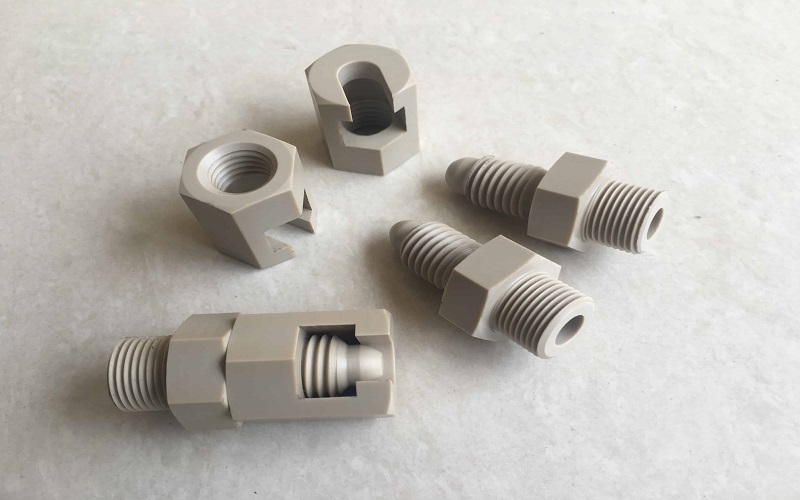
There are few industrial settings more unforgiving than the semiconductor fabrication space. In the wet processes that clean, etch and plate silicon wafers, some of the most aggressive chemistries in manufacturing are used – hydrofluoric acid, hot sulphuric-peroxide mixtures, and ammonia-based cleaning baths – delivered at purity levels where contamination is measured in parts per billion and, increasingly, parts per trillion. A single metal ion leaching out of a pipe wall, or a microscopic particle flaking off a valve seat, can destroy an entire lot of wafers.
It is no surprise then that fluoropolymers are the material of choice for fluid handling in semiconductor manufacturing. No other family of materials combines near-universal chemical inertness with the cleanliness that these processes require. But in that family, two materials vie for nearly every application: PTFE, the original fluoropolymer, and PFA, its melt-processable offspring. They are chemically close cousins, so close that their datasheets can look almost interchangeable. But there are real ramifications for purity, part design and cost in choosing one over the other.
Two Polymers, One Chemistry
PTFE (polytetrafluoroethylene) is a homopolymer of tetrafluoroethylene, long chains of carbon coated in fluorine. This structure gives it the properties the industry has come to know and love: chemical inertness against just about anything a fab can throw at it, a continuous service temperature of 260°C, and the lowest coefficient of friction of any solid material.
PFA (perfluoroalkoxy alkane) is based on the same TFE backbone but contains a small proportion of a perfluoroalkyl vinyl ether comonomer. The pendant alkoxy groups disrupt the crystal structure just enough to allow the polymer to melt and flow without sacrificing the fully fluorinated chemistry that makes PTFE inert. The result is a material with essentially the same chemical resistance and the same 260°C service temperature but one that can be injection-moulded, extruded and welded like a conventional thermoplastic.
That one difference—melt processability—drives almost all of the practical differences between the two materials in a fab environment.
Why Purity and Melt Processability Matter
PTFE cannot be melt-processed. It is so viscous above its melting point that it must be compression moulded from powder and sintered. This is more like powder metallurgy than plastics moulding. The process involves machining finished components from sintered stock. Done well this gives good parts, but the sintering route has two implications for high-purity service.
Sintered PTFE is slightly microporous. Its surfaces, even finely machined, are not as smooth or dense as a melt-formed surface. Porosity and surface roughness in ultrapure chemical lines evolve to increased particle shedding, increased surface area for chemical entrapment and increased permeation of aggressive media over time.
Second, machining is an inherently variable process. Each tool pass generates a new surface, and the quality of that surface is a function of the tooling, feeds, and speeds, all of which need to be tightly controlled when the component is sitting in a chemical delivery line feeding a process chamber.
In contrast, PFA develops its last surface in the melt. The bore of extruded PFA tubing is smooth, glass-like and non-porous. Injection-moulded PFA fittings and valve bodies produce complex geometries without worry about weld lines or machining debris. High-purity PFA grades are manufactured with tightly controlled ionic extractables – important when a single sodium or iron ion in the wrong place can change device behaviour. This is why in modern fabs the chemical delivery path itself, tubing, fittings, valves, pump wetted parts, and filter housings are overwhelmingly PFA.
PFA has one more, under-appreciated advantage: it is see-through. Operators can visually verify fluid flow and detect bubbles and two-phase conditions in a PFA line—something that is impossible with opaque PTFE.
When Still Wins PTFE
If PFA is better in the delivery line, why is PTFE still everywhere in the fab? The reasons are three: size, sealing and economics.
PFA resin is several times the cost of PTFE. Injection moulding is only cost-effective at volume. For large components – wet bench tanks and liners, large, machined blocks, manifolds, chuck components, and structural parts in etching and cleaning equipment – compression-moulded and machined PTFE is both more economical and more practical. Sintered PTFE stock is available in sizes unmatched by any melt process.
PTFE is also the default for the seal. Its softness and conformability make it the natural choice for gaskets, seals, seats and envelope gaskets where a degree of cold flow will help the material to bed into mating surfaces. And for machined one-offs, prototypes and low-volume custom geometries – the reality of much equipment building – machining PTFE is much more accessible than tooling up a PFA mould.
Modified PTFE (covered in an earlier post) narrows the gap even further, with denser,
A Quick Selection Guide | | |
Attribute | PTFE | PFA |
Chemical resistance | Outstanding | Outstanding |
Continuous service temperature | 260°C | 260°C |
Processing | Compression moulding + sintering, machining | Injection moulding, extrusion, welding |
Surface / porosity | Slight micro-porosity; machined surfaces | Dense, smooth, melt-formed surfaces |
Purity / extractables | Good; process-dependent | Excellent; high-purity grades available |
Transparency | Opaque | Transparent |
Creep / cold flow | Higher (aids sealing) | Lower |
Relative cost | Economical, especially in large sections | Significantly higher |
Typical fab use | Tank linings, wet bench components, gaskets, seals, seats, large machined parts | Tubing, fittings, valves, pump internals, filter housings, wafer carriers |
lower-porosity structures and better weldability than conventional PTFE.
The Opportunity in India
For Indian manufacturers, this question is no longer theoretical. With the country's first fabs and OSATs in construction and first production targeted in the coming year, a domestic ecosystem for fab infrastructure – chemical delivery, ultrapure water systems, and wet process equipment – is beginning to take shape. The fluid handling components for these facilities have traditionally been imported. An obvious next step for India’s polymer industry is to develop local expertise to manufacture and qualify precision fluoropolymer components, so they meet the expectations of the semiconductor grade.
Poly Fluoro machines and moulds both PTFE and melt-processable fluoropolymers to tight tolerances required by critical fluid handling applications. In semiconductor fluid handling, the difference between two similar polymers can be the difference between a clean process and a contaminated one – and that’s why we help our clients make the material decision early on, whether it’s a machined PTFE manifold, a modified PTFE seal or a PFA wetted component.
Read More
1. Short Neutral Sections in Railways Inside the PTFE Insulating Member
2. PAI - The Strongest Melt-Processable Polymer – Properties, Grades, and Applications
3. PTFE in Brake Cables